The abstract.
In explaining optical phenomena such as the aberration of starlight and the Michelson–Morley experiment, the Special Theory of Relativity (SRT) faces (in our opinion) certain difficulties, which, however, turn out to be only apparent and can be eliminated if two additions proposed by the authors are introduced into SRT:
A)The mobility hypothesis, which consists in the statement that there is an absolute, privileged frame of reference associated with the electromagnetic (light) wave itself, which can be conditionally called
“Light reference system” or “C – system”. This frame of reference is not inertial. We will call the movements and velocities of any bodies and systems relative to this system “additional” movements and velocities (to the speed of light that always exists in the “C–system”).
B)The auto-correction hypothesis, which states that when the source of electromagnetic waves and the receiver (observer) move relative to each other, such that their mutual velocity is perpendicular to the direction of propagation of light waves, the wave front rotates by an angle φ, where tg = β/(1—β2)1/2,
β=v/c. This rotation also takes place when the source and receiver are stationary relative to each other, but have some “additional” speed relative to the “C–system”.
Introduction. Description of the problem.
- The aberration of starlight was discovered and explained by D. Bradley in 1727. Aberration, i.e., a change in the apparent position of the sun on the celestial sphere, is caused by the finiteness of the speed of light and the movement of the observer due to the rotation of the Earth around the Sun at a speed of 30 km/sec. [ 1,2,3] Strictly speaking, Bradley did not detect an aberration, but its annual change. If the Earth moved uniformly and rectilinearly in space, it would be extremely difficult to detect the aberration of starlight. Thus, no “age-old” aberration has been detected. It is related to the movement of the Solar system relative to nearby stars and the rotation of “our” branch of the spiral Galaxy around its center at a speed of ~220 km/sec.
Later, D.Airy carried out his famous experiment with a telescope filled with water in 1871, and unexpectedly obtained the same aberration value as Bradley, i.e. 20.5″ (arc sec.)* Aberration and Airy’s experiment were more or less successfully explained within the framework of the classical wave theory of light, using Fresnel’s theory of partial entrainment of light by a moving medium, as well as SRT. [1,2]
The difficulty of explaining aberration from the standpoint of SRT lies, in our opinion, in the fact that this explanation generates a seeming contradiction between the first and second postulates of SRT. In fact, aberration can be observed when the relative motion of the light source and the observer is relative, provided that their mutual velocity is perpendicular to the line of sight, i.e. the direction of propagation of the light wave. The simplest mental experience, in which the Earth “stops” relative to, say, the Sun, and the star “rushes” in the opposite direction of the Earth’s movement, raises the question: will there be an aberration on the “stationary” Earth in this case? If we assume the correctness of the 2nd postulate of the SRT about the constancy of the speed of light and its independence from the motion of the source, then aberration on Earth will not be observed. Indeed, the light emitted by a moving source (a star) will not receive any additional lateral velocity and therefore there will be no aberration. On the other hand, both the Earth and the star can be considered (with certain limitations) equivalent inertial reference frames and, therefore, aberration should be observed in both cases, regardless of WHAT is moving relative to WHAT – the 1st postulate of the SRT. Thus, there is a contradiction between the first and second postulates of the SRT.
{Interestingly, if we assume the correctness of the “transverse” Ritz principle (otherwise called “emission” or “ballistic”), then the light wave emitted by a moving source should receive an additional lateral velocity and aberration would be observed in both cases. However, the Ritz principle contradicts the basic concepts of wave theory and is not confirmed by experiments.} [1,2,4-6,8]
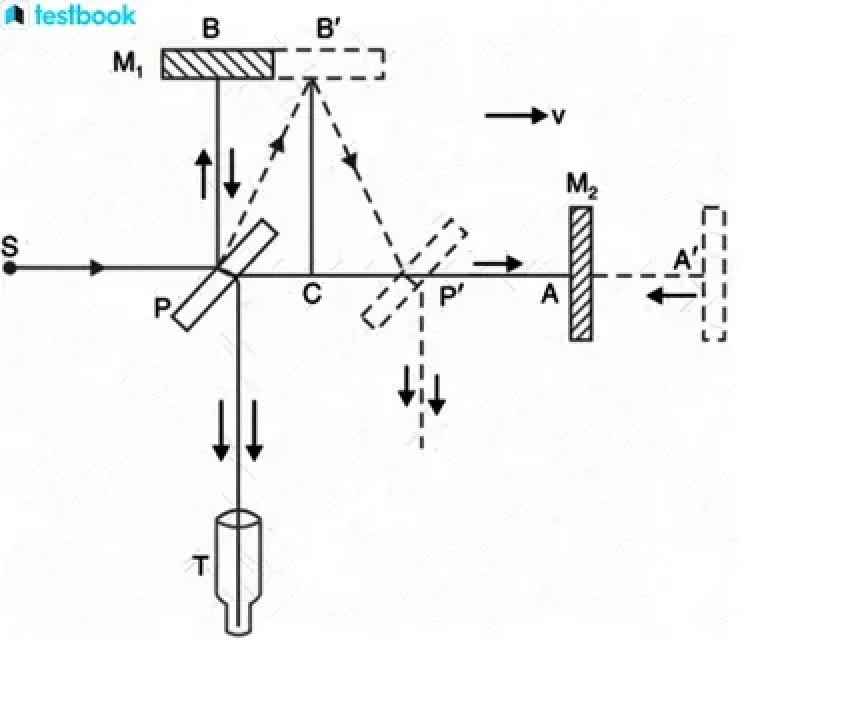
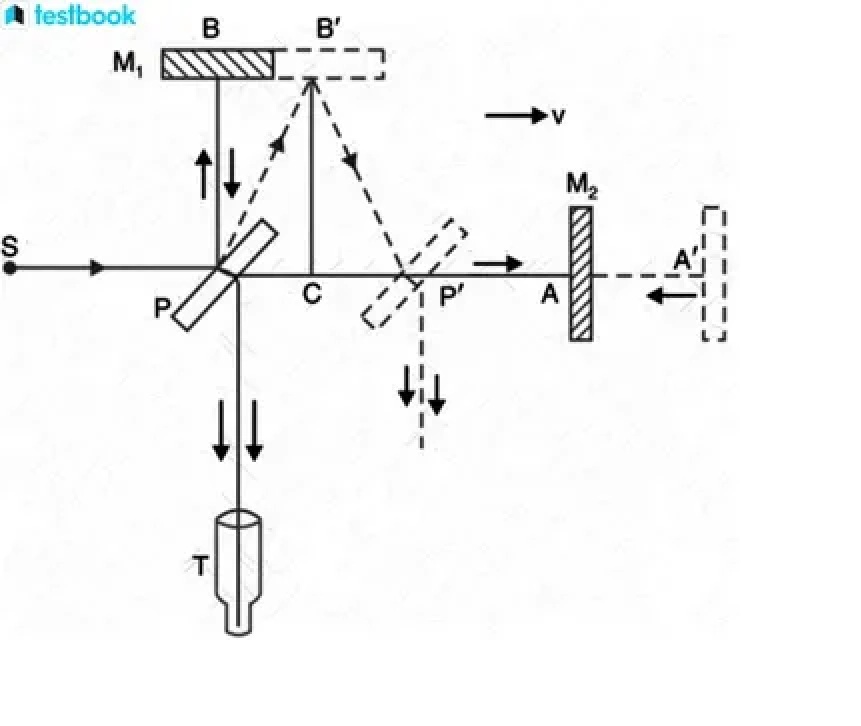
- The Michelson–Morley (MM) experiment, the negative result of which is explained by SRT by introducing two effects: shortening the lengths in the direction of motion and slowing down the passage of time in a moving inertial reference frame, nevertheless creates difficulties in explaining the behavior of a beam transverse to the motion of the Earth. [1,2,7] Again, if the 2nd postulate of the SRT is true, the movement of the Earth should not affect this transverse ray in any way, and it should “lag behind” the Michelson-Morley installation during its journey to the reflecting mirror and back.[1,2,4-7] (Fig.1)That is, to deviate “back” by 2.2 mm, which could easily be detected, given the high sensitivity of the method ~ 0.01 λ. In all literary sources, however, the transverse ray is depicted as leaning “forward”, as if it is being carried along by the forward movement of the Earth, along with the installation. The M-M experiment, as is known, did not detect any “backward” shift of the transverse beam. A contradiction arises again: if the second postulate of the SRT is true, this ray should deviate “backwards”, because the movement of the Earth does not have any entraining effect on the transverse ray. At the same time, if a “backward” shift were observed, it would contradict the first postulate of the SRT, i.e. the principle of relativity, about the impossibility of detecting the movement of the Earth relative to the “fixed” ether.
We knowingly reject here the idea of ether being completely carried away by the movement of the Earth, as well as the deliberate rotation of the transverse beam “slightly forward” as untenable and incorrect. Neither the experimental data, nor the theoretical provisions, nor the technical data of the installation confirm such assumptions. [7] Similarly, for the reasons stated earlier, we reject the explanation using the Ritz principle.
Below, we will show that in both of these examples, the above contradictions are only apparent and can be resolved by introducing two additional assumptions: the mobility hypothesis and the auto-correction hypothesis.
The mobility hypothesis and the auto-correction hypothesis.
The Mobility Hypothesis (GM) asserts the existence of an absolute,
a privileged frame of reference associated with the electromagnetic (light) wave proper, conventionally called the “light frame of reference” or “C – system”.
This “C–system” is not an inertial reference system, nor is it a non-inertial reference system. Any laws of physics are not invariant with respect to this system. Its uniqueness lies in the fact that no “ordinary” frame of reference can rest relative to the “C–system”, and that the “C–system” cannot be stopped. The photon is also known to occupy a unique place in the table of elementary particles.
We will call the movements and velocities of any bodies and systems relative to the “C–system” “additional” movements and velocities. All calculations of these speeds are carried out according to the SRT formulas. An inertial reference system that exists in nature or is artificially created and does not have any “additional” velocity relative to the “C–system” is in no way a privileged reference system in relation to an infinite number of other inertial systems.
The introduction of an absolute frame of reference automatically entails the concept of absolute motion, which is in clear contradiction with the principle of relativity, which denies the very existence of such a concept as having no physical meaning. (Since there is no absolute space and its material substratum, the immobile ether). However, if we assume that such motion cannot be detected in principle by an observer located inside an inertial frame of reference, then this contradiction is removed.
There are two possible situations for the “Light Source – Light Wave – Observer” system:
If the source and the observer are in an inertial reference frame and are at rest relative to each other. Then there is no fundamental possibility for an “internal” observer to detect the “additional” motion of this system, i.e. the principle of relativity is fulfilled.
If the source and the observer are moving relative to each other. In this case, their movement can be detected due to aberration and Doppler effects (longitudinal or transverse).
Summarizing, we can say that there are three classes of reference systems: inertial, non–inertial (accelerated) and “C- system” – absolute, unique and privileged.
The auto-correction hypothesis** (HA) includes three theses:
A) When a light wave is reflected from an “additionally” moving mirror, the wave front experiences some additional rotation by an angle φ, where t g g=v/c, v is the “additional” speed of the mirror, c is the speed of light, or, more precisely, t g g = β/(1 — β 2)1/2, where β = v/c. That is, the angle of incidence is not equal to the angle of reflection for the case of a moving mirror. This formula is nothing more than an expression for the angle of aberration of starlight.
B) With the “additional” movement of the light source relative to the “C–system” or the observer, the front of the emitted wave rotates “forward” (in the direction of motion) by the same angle φ (see the previous paragraph).
C) An observer located on a plane whose velocity vector lies in the same plane perceives a perpendicular light wave incident on him not as perpendicular, but with an inclination “slightly in front”. The angle of inclination in this case is equal to φ, as in the first paragraph. (Fig.2)
There is no fundamental way for an observer to distinguish such a “perpendicular” wave from a “truly” inclined one. When we talk about an “observer”, we mean any system of optical devices capable of recording such parameters of a light wave as amplitude, phase, frequency, etc. We do not mean a system of optical devices that rotate the wave front, such as mirrors, lenses, diffraction gratings, etc. [1,9]
Both hypotheses are interrelated and are used together in most cases.
- Application of the above hypotheses for cases of aberration and the Michelson-Morley experiment.
A) Aberration. In the case when the Earth is moving and the star is at rest relative to, say, the Sun, an observer on Earth will find that the light wave from the star falls to the Earth not strictly perpendicular, but obliquely, slightly from the front according to thesis “B” of the auto-correction hypothesis.
In the case when the Earth is “at rest” and the star is moving relative to the Sun in the opposite direction of the Earth’s movement, the light wave will again be perceived by an observer on Earth coming slightly from the front, as in the previous case. (According to thesis “B” of the auto-correction hypothesis)
Thus, using the auto-correction hypothesis, we remove the mentioned difficulties of SRT, and eliminate the contradiction between both postulates without sacrificing either of them. Neither the principle of the constancy of the speed of light nor the principle of relativity suffer from this explanation.
It is interesting to consider the case when the plane in thesis “B” is replaced by a mirror. Then the light wave incident perpendicular to this mirror, according to “B”, will be reflected “backwards”. According to the Ritz principle, it should be reflected “forward”, as if carried away by the movement of the mirror. This provision of thesis “B” of the auto-correction hypothesis needs, of course, experimental verification. However, it is precisely this “mirror” version of thesis “B” that will cause some difficulties in explaining the Michelson–Morley experiment in the future.
B) The Michelson–Morley experiment.
Here, the displacement of the transverse beam is always “forward” with any orientation of the M–M installation, easily explained by theses “A” and “B” of the auto-correction hypothesis. Moreover, the course of the rays will coincide with the theoretically predicted and experimentally obtained results. (Fig.3) The problem, however, arises when trying to consistently use all three theses of GA, in particular, the “mirror” version of thesis “B”. (Fig.4) In this case, we got strange results: first, both beams (longitudinal and transverse) come to the telescope from different points of the semi-silvered plate (beam—splitter), and not from one, as follows from the description of the experiment of M-M. Secondly, the difference in the course of both rays turns out to be different than it is calculated in the conventional descriptions of the experiment and has been experimentally confirmed.
The most unpleasant conclusion that follows from the consistent use of all three theses of GA (if the “mirror” version of thesis “B” is also valid)is the possibility for an “internal” observer located in an inertial frame of reference to detect his movement, i.e. to detect absolute motion relative to the “C–system”. Using only the transverse beam and applying all three theses of GA, we find an uncompensated deviation of the transverse beam “back” half the way, which differs from the conventionally accepted one. Thus, there is a formal contradiction with the principle of relativity. It is “formal” because the principle of relativity proclaims the absence of absolute motion relative to a privileged inertial reference frame, which the “C –system” is not!
We would like to discuss the experience of MM in terms of the auto-correction hypothesis in all its details, but the size of the article does not allow this. It should only be noted that the explanation of the experience of MM is much more complicated than it is presented in the conventional interpretation.(See Fig.3 and fig. 4 and their explanations)
The question arises: why was it necessary to introduce the hypothesis of mobility, postulating the existence of an absolute and privileged frame of reference, if so far it has never been mentioned and all explanations were based on the hypothesis of auto-correction?
There are two reasons. First: the need to explain the forward deflection of the transverse beam. Indeed, GA always talks about the movement of the source or observer not only relative to each other, but also about their movement relative to the “C–system”. Moreover, even in the case when they are both at rest relative to each other, GA effects should exist if they are moving relative to the “C–system”. First of all, this applies to the M-M experience, where the light source and the observer are stationary relative to each other. (The experiments of D. Miller and R. Tomasek using the light of the Sun and stars as light sources, in our opinion, do not fundamentally change anything. Indeed, in order for light from the Sun or stars to reach the semi-silvered plate of the M-M installation, it inevitably had to interact with some kind of optical system located on Earth, and therefore at rest relative to the M-M installation. Thus, this optical system becomes a light source moving with the Earth) [5,6]
The second reason: How can we explain thenegative result of the M-M experiment for an observer who is motionless relative to the M-M installation? The Fitzgerald–Lorentz scale reduction and time dilation formulas can only be applied when the installation is moving relative to the observer or relative to something else. For Lorentz, this was the movement of the M-M installation relative to the luminiferous ether, and then there would indeed be a shortening of the lengths (along the movement) and a slowing of the passage of time. But SRT rejects the very concept of ether as a fundamentally unobservable physical phenomenon, and therefore non-existent. So what is the observer moving relative to, motionless in a frame of reference connected to the Earth, in order to explain the negative result of the experiment? We have no choice but to introduce a “C-system” relative to which the M-M installation is moving, i.e. the M-M installation has some “additional” speed relative to the light wave and for it, for the light wave, the longitudinal arm of the M-M installation is actually shortened. At the same time, we do not introduce anyprivileged inertial frame of reference.By introducing the mobility hypothesis, we fully preserve the SRT, eliminating only the difficulties it faces.
4) Effects related to the mobility hypothesis and the auto-correction hypothesis.
The auto-correction hypothesis predicts some effects that should be observed when electromagnetic waves are emitted or reflected by fast-moving objects, for example:
Prominences in the Sun. Here, according to HA –B, deviations of the apparent position of the prominences from their actual location in relation to the Sun should be observed.
Fast-moving double stars. According to the same thesis of GA–B, aberration will change their apparent position and generate apparent positive and negative accelerations of moving stars that are inconsistent with the Doppler shift of their spectrum. The ratio between the longitudinal and transverse Doppler shifts will also change, which will be difficult to verify, since the aberration will “mask” the transverse Doppler effect. [10]
Fast-moving plasma clumps and mirrors. In the latter case, in accordance with HA – A and B, an additional rotation of the reflected beam will be observed, which does not correspond to the law of geometric optics for stationary media. Once again, we emphasize that GA – B predicts the reflection of a light wave perpendicular to a moving mirror “backwards”.
As for the mobility hypothesis, it would be possible to predict a certain predictable effect: the transverse Doppler effect (due to the orbital motion of the Earth) for electromagnetic radiation from a non–existent source – Cosmic microwave Background (in Western terminology). Since the principle of relativity is inapplicable to non—inertial systems, and the “C-system” is neither inertial nor non-inertial, the transverse Doppler effect should not be observed in this case. If it is nevertheless observable, this can only indicate that the SRT predictions also apply to “C–systems”, which does not mean, however, that the SRT conclusions extend to accelerated reference frames. Otherwise, we return to the well-known “twin paradox.”
Of course, only an experiment can confirm or refute the above reasoning.
Conclusion.
The proposed mobility hypothesis is not as strange or unusual as it seems at first glance. In many articles devoted to the problems of optics of moving media, phrases such as “the medium moves relative to an electromagnetic wave” or something similar are often found.
In works devoted to Cosmic Microwave Background Radiation (RI), one can also find statements: “the real motion of the Galaxy in relation to a fixed microwave background” (in the discussion of the so-called dipole anisotropy of RI), etc. “Aberration, of course, ceases to be a first-order effect if the light wave and the observer are not in motion relative to each other. a friend” – a quote from the book by M.Born. [2]
Moreover, by introducing the “C-system”, we eliminate the implicit use of the concepts of absolute space and time that exists in physics to this day. Let’s take the definition of speed as such an example.
The velocity of a point is defined as the time derivative of the path, where, of course, the velocity is a function of the arguments of the path and time, v=dS/dt.
But, according to SRT, the path, distance, length, and duration of the time interval are functions of the relative velocity of the systems, and a vicious circle is formed where velocity is a function of arguments that themselves are functions of velocity. In our opinion, it is more reasonable to set speed as a primary concept, in fractions of “C” – the speed of light, and space and time as secondary.
Summarizing all of the above, we note that the proposed additions contain one principle (the mobility hypothesis) and one possible physical mechanism (the auto-correction hypothesis) explaining some of the effects. Both of these additions in no way contradict the SRT, but only complement and reinforce its fundamental provisions.
Literature.
- A.Einstein, G.A. Lorentz, G. Minkovsky, G. Weil, “The principle of Relativity”
- M. Born, “Einstein’s theory of relativity”
- V. Kulikov, “Fundamental astronomical constants”
- R. Feynman, R. Layton, M. Sands, “Feynman lectures on Physics”
- M. A. Tunnela, “Fundamentals of electromagnetism and the theory of relativity”
- V. Panovsky, M. Philips, “Classical electrodynamics”
- A. A. Michelson, “Studies in Optics”, 1995, Dover, New York
- A. A. Michelson, „Effect of reflection from a moving mirror on velocity of light“, J. Optical Society of America, 1913
- L. D. Landau, E. M. Lifshits, “Electrodynamics of moving media”, 1964
- H.Ives, G. Stilwell, “An experimental study of the rate of a moving atomic clock”, J. Optical Society of America, V.28. #7, 1938
Notes.
* The result of the Airy experiment can also be explained if we assume that the refractive index of the medium remains constant, regardless of the direction of mutual motion of the medium and the light wave propagating in it. Then the speed of light in water in the direction opposite to the speed of the Earth will also not be “v”, equal to v3 if = 30 km/sec, but v’= v/n, where v is the speed of the Earth and n is the refractive index of the medium. Then tg= v’/c’ = v/n /c/n = v/c, i.e. the result of the Airy experiment.
** The theses given below are partially contained in the works of Fresnel and SRT, but in an insufficiently emphasized form, in our opinion. Of course, in addition to the rotation of the wave front, there will also be a change in frequency. However, it was not our intention to consider this phenomenon.
11 VII 2002

 Esprit de L'escalier