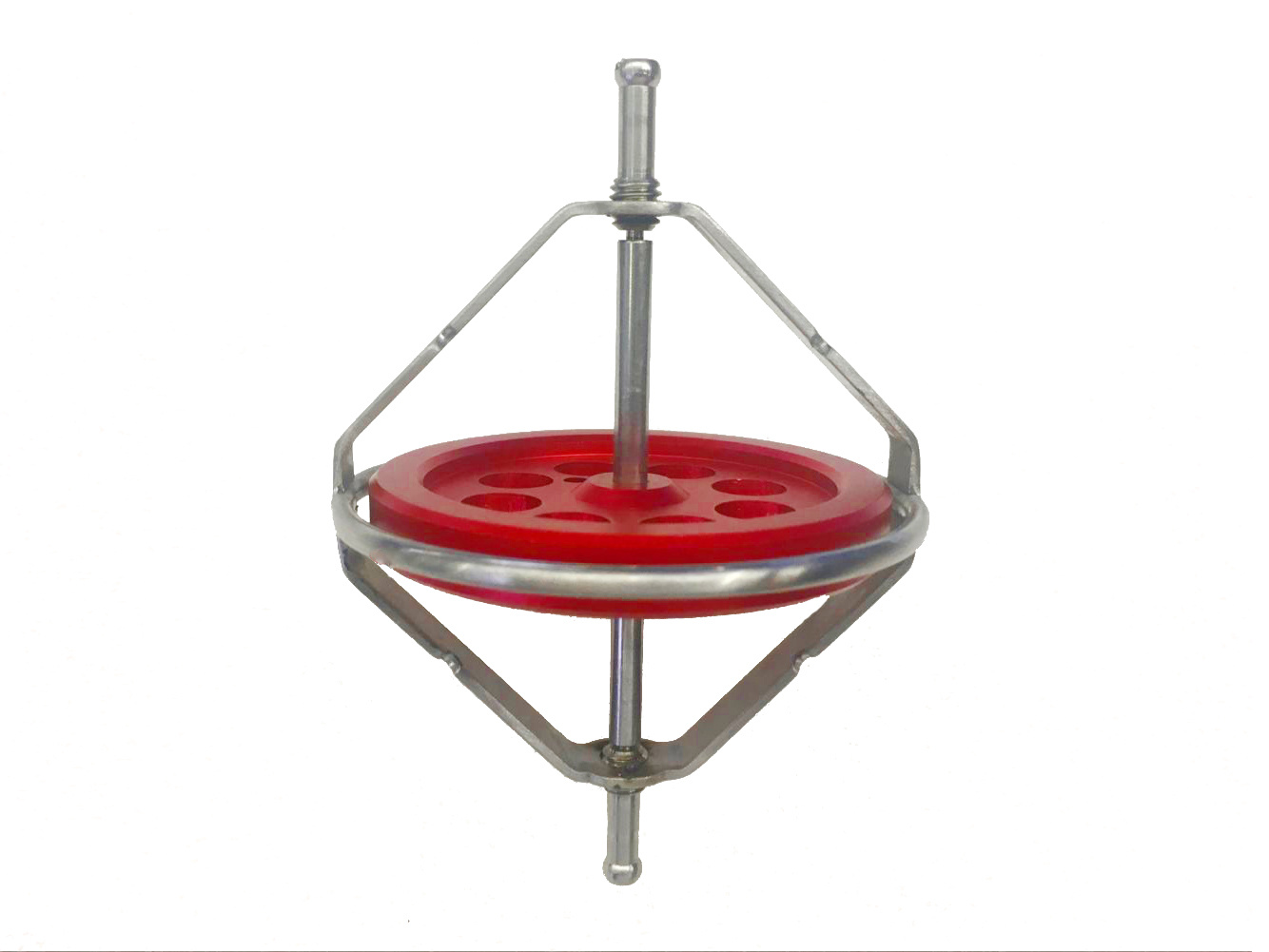
But the gyroscope is really a strange thing.
A disk is spinning at high speed on an axis.
We know from mechanics that any action causes a reaction (Newton’s Third Law). It is understandable – the forces of inertia, elasticity, and so on.
When a car, bus, or train brakes sharply, passengers and any objects are torn from their seats and fly forward, because INERTIA. When an astronaut in a rocket, or a pilot in a military plane, feels that an “unknown force” is pressing him into a seat, he knows that this is the force of inertia. So, any body with a so-called rest mass also has inertia. And its mass is a measure of this inertia. Because of the rapidly increasing inertia, no body with a rest mass not equal to zero can be accelerated to the speed of light.
But the gyroscope is strange in that it seems to be inert, but in a very peculiar way.
If we try to turn its axis of rotation, it does NOT RESIST our attempt by its inertia, but rather tries to “slip out” from under the influence.
Its axis begins to deviate in a direction perpendicular to our influence.
Why?
Let’s do a mental experiment.
Imagine that we have a gyroscope, that is, a rapidly rotating disk on an axis. The axis coincides with the plane of this page and is positioned vertically. Then one edge of the disk is on our side of the page, and its opposite part is “on the other side” of the page. Let’s further imagine that the disk rotates from left to right on our side. According to the rule of the gimlet, its axis of rotation is directed from bottom to top.
Let’s imagine now that, without slowing down the rotation of the disk at all, we try to lower its part facing US downwards. To analyze what is happening, we use such a simple technique: mentally break our disk into many cubes and see WHAT happens to these cubes.
The cube, which is on the edge of the side of the disk facing us, is lowered by our efforts. But WHAT does this mean for this cube? Its speed does NOT change in magnitude!
Its velocity does NOT change in the direction either, it experiences a kind of “parallel transfer”, a shift lower, but in the same direction and at the same speed. It’s the same with the other side of the disk. There, too, the cube moves parallel to itself, but upward.
But parallel to his previous movement!
However, since neither the speed of the cubes nor the direction of their movement CHANGE, it means that no “inertia force” arises!
Let’s remember this important conclusion!
Now let’s mentally move ninety degrees and see what happens to our cubes flying THROUGH the plane of the page.
Here the picture is completely different: trying to lower our edge of the rotating disk, we force the cubes there, in the plane of the page, to MOVE upward. It’s on the right. And on the left, we make them move down. These things are already causing a “natural protest” in matter, we are changing the direction of their movement! A change in direction is already a gross violation of the previous state, and INERTIAL forces arise that tend to turn the axis of the disk to its previous position. The moment of THESE inertia forces in our case is as follows: on the right, the cubes in the page plane tend to descend, that is, to maintain the previous direction of movement, and on the left, to rise. There is a certain torque of forces that tends to turn the axis of our disk clockwise in the plane of the page.
In other words, we have come to the amazing property of a gyroscope that it tries to “slip out” from under our influence, turning perpendicular to the direction of the applied force disturbing its normal rotation.
Thus, we have just explained this mysterious property of the gyroscope to “slip out”. The cubes in front and behind in relation to us do not respond to our attempt to change the state of their rotation, since no fundamental changes in their state occur due to our efforts. But the cubes in the plane of the page still experience a change in their state and they react to our influence, trying to maintain the “Status quo”.
That’s all.
The mystery has disappeared and we have figured out a rather complex physical phenomenon without mathematics and without filling the page with a lot of formulas that DO NOT EXPLAIN the reasons, but only state a certain fact! And very often they create only the APPEARANCE of an explanation where there is NO explanation!
Why?
Yes, because mathematics is essentially ABSTRACT, “from birth”, it doesn’t care WHAT we mean by this or that symbol. It’s important to her that we juggle these symbols strictly according to her rules, AND THAT’s IT!
And THE CAUSES OF phenomena ARE ALWAYS SPECIFIC!!!
And being SPECIFIC is NOT INCLUDED in the tasks and nature of mathematics!
Therefore, mathematics does not explain anything and is not even interested in the reasons.
She only states:
WHAT HAPPENED.
WHAT IS THERE.
what will happen.
If we manipulate her symbols according to strict rules formulated by her, we get answers to these three questions.
BUT THIS IS NOT AN EXPLANATION OF THE REASONS!
That’s the difference between natural science (WHY?) and the language of mathematics (WHAT and HOW?)
30 I 2020

 Esprit de L'escalier