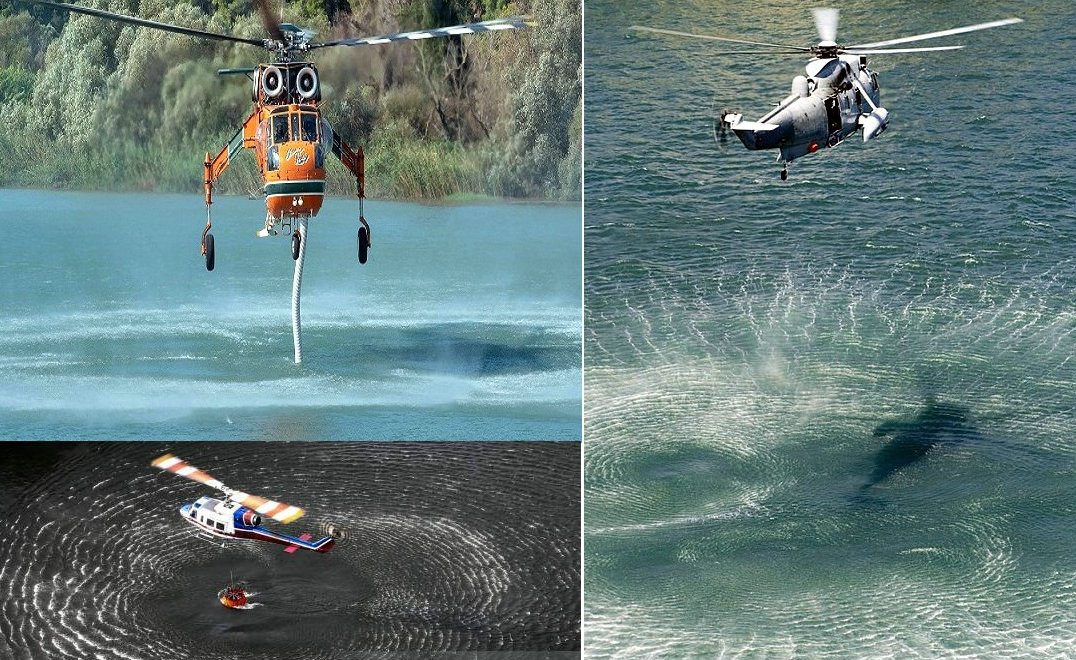
In the photos: Helicopters are hanging above the water, collecting water into an overhead tank or through a pipe into a reservoir inside the hull.
Under the helicopter, the surface of the water is SMOOTH, “pushed through” by a powerful and relatively uniform air flow from its blades, and only BEYOND the PERIMETER of the circle are visible radially diverging undulations.
CONCLUSION: The ends of the propeller blades rotate at supersonic speed, throwing air VERTICALLY DOWN!
The aerodynamics is bothering me.
Today, while preparing breakfast, I thought again about it and came to another “paradoxical” conclusion for me (perhaps long known to experts in aerodynamics):
The angle of the air deflected by the incoming wing of the aircraft VARIES DEPENDING ON THE SPEED OF THE APPROACH, deviating more and more “forward” to the vertical as the speed increases, towards the movement of the aircraft WITH A CONSTANT ANGLE OF ATTACK OF THE WING!
The meaning is simple: At low speed, the air is not thrown completely down, but only partially, leaving from under the wing obliquely backwards. Therefore, during takeoff and landing, that is, at relatively low speeds, flaps extended from the wing with a large angle of attack are used to increase the impuls of the air being thrown DOWN.
At high speed ALL the air deflected by the wing, even at low, optimal angles of attack, is thrown almost vertically downwards.
As mentioned at the beginning, perhaps this has long been known and formulated in aerodynamics in the form of some kind of aerodynamic principle, or perhaps this phenomenon is accepted without any explicitly formulated strict rules or formulas simply “BY DEFAULT”.
For example, the lifting force of a helicopter rotor is calculated taking into account the ejected mass of air and the speed of rotation of the ends of the rotor blades, that is, we are talking about the total impuls of the mass of the air being thrown DOWN.
The law of geometric optics: “The angle of incidence is equal to the angle of reflection” is applicable only in light, the speed of which is always constant and equal to 300,000 km/sec.
But even HERE, this law IS NOT FOLLOWED if the reflecting plane IS MOVING!
(See the picture of the path of the beams in Michelson’s experiment! It is clearly visible there that the beam, transverse to the velocity vector of the Earth’s orbit, is DEFLECTED forward!)
Since even light changes the angle of reflection at a constant velocity in MAGNITUDE, but NOT IN DIRECTION, liquids and gases must also change the angle of reflection – deviations depending on the velocity of the incoming medium!
The conclusion may be somewhat speculative and even fantastic, but it seems to me to be true!
Faciant meliora potentes.
If I’m wrong, let my seniors correct me,
25 II 2026
P.S. I think that it is not difficult to explain this effect.
When an air stream hits an inclined plane at a relatively high speed, it is not only slightly deflected downwards by it, but also compressed due to viscosity and inertia. The new incoming air masses shift this volume of compressed air to the trailing edge of the wing, and since this area has a higher density than the surrounding air and it expands, a kind of flap appears at the trailing edge of the wing, throwing the air masses down!
This is how the air flow is generated, deflected by an almost horizontally positioned wing with an optimal angle of attack, almost vertically down!

 Esprit de L'escalier