.
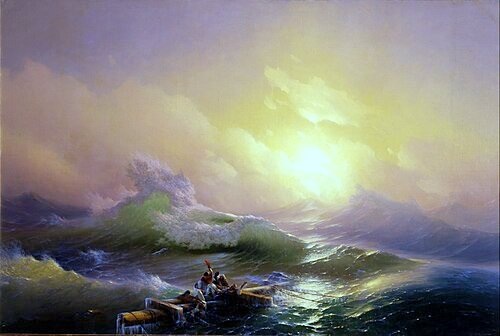
Let’s leave the question of whether it exists, this Ninth Wave, without consideration and “axiomatically” assume that it does!
What caused it, the Ninth, or the Eighth, or the Tenth?
Its number does not change the essence of the phenomenon.
Based on the well-known explanation of the nature of the waves (See, for example, Einstein’s article “Elementary theory of flight and waves on water”, 1916, which contains completely correct and completely ridiculous statements), it is clear that pressure changes in the air flow (wind) above the free surface of the water, combined with gravity, viscosity and surface tension forces, such as they cause local rises and movement of waves.
This was also understood by Pushkin, who, although he was very weak in physics and mathematics, nevertheless wrote correctly in The Bronze Horseman:
«But the wind driving from the bay
Dammed Neva back, and she receding
Came up, in wrath and riot speeding:
And soon the islands flooded lay.”
We, however, are interested in this most mystical “Ninth”. Does this mean that there are some QUASI-REGULAR fluctuations in wind velocity (and hence pressure) in the wind flow itself?
It’s hard to believe.
So, the hypothesis.
In an excellent monograph by an outstanding chemist and, in general, a widely educated person, B.V.Nekrasov, “Course of General Chemistry”, a copy of which (Eleventh edition, 1954. In 20 years, ELEVEN EDITIONS!!!) available in my library, I read about the amazing property of ozone.
Mercury, as you know, does not “wet” glass, does not “stick” to it, but “The slightest traces of ozone cause it to stick to glass!”
What does this mean? Since it does NOT stick, it means that the internal adhesion of mercury molecules to each other is stronger than the forces of their adhesion (capillary) to glass. But it follows from the described phenomenon that even “TRACES OF OZONE”, that is, its NEGLIGIBLE concentration in the air, already WEAKENS the forces of the intermolecular bond of mercury and the forces of adhesion of its molecules to glass begin to prevail! Ozone probably dissolves well in mercury, or at least it has good adhesion, that is, surface adhesion.
The mechanism of this phenomenon is unclear to me, but there is a clear hint:
This is most likely some kind of CATALYTIC reaction.
Ozone– a catalyst, in the smallest concentrations, causes a significant change in the forces of internal adhesion.
That is, ozone, in relation to mercury, REDUCES its “internal friction”, its viscosity as a whole, as a liquid. And, apparently, her chemical reactions with other substances…
Not so long ago, I noticed, while playing with a weak (for refrigerators) ozone generator, that ozone seemed to NOTICEABLY reduce the viscosity of water, making it more fluid! (Similar to traces of iodine, see the notes on “partial superfluidity of Iodine Water”).
This means that ozone should significantly affect many processes related to the viscosity of water: for example, evaporation-boiling-condensation and freezing-melting. Perhaps a number of chemical reactions in water will take place differently if there are even traces of ozone? It is clear that, say, aqueous colloidal solutions will agglutinate more quickly if the viscosity of the water decreases.
In addition, as I have already mentioned, ozone has the ability to seep through polymer films due to a Chain Reaction of Substitution (See the relevant notes, for example, “Ozonated bread”)
Perhaps ozone also affects the viscosity of the air, increasing the condensation of steam, the fusion of water droplets and their fall by rain or hail.
Hence the hypothesis of the “Ninth Wave”:
Due to the usually stormy weather at sea, with frequent lightning, a certain amount of ozone is formed, which is almost twice as heavy as air (2.14 kg/cubic meter) and, unlike ordinary oxygen, dissolves very well in water (49 volumes of ozone per 100 volumes of water).
This makes the water more FLUID in PLACES where ozone accumulates randomly over a certain part of the surface of a raging sea, which means it can create the HIGHEST WAVES, all other things being equal!
So much for the “Ninth Wave”!
I remind readers that I am not a chemist, geophysicist, or meteorologist!
Faciant meliora potentes.
If I’m wrong, let my seniors correct me.
30 V 2025

 Esprit de L'escalier