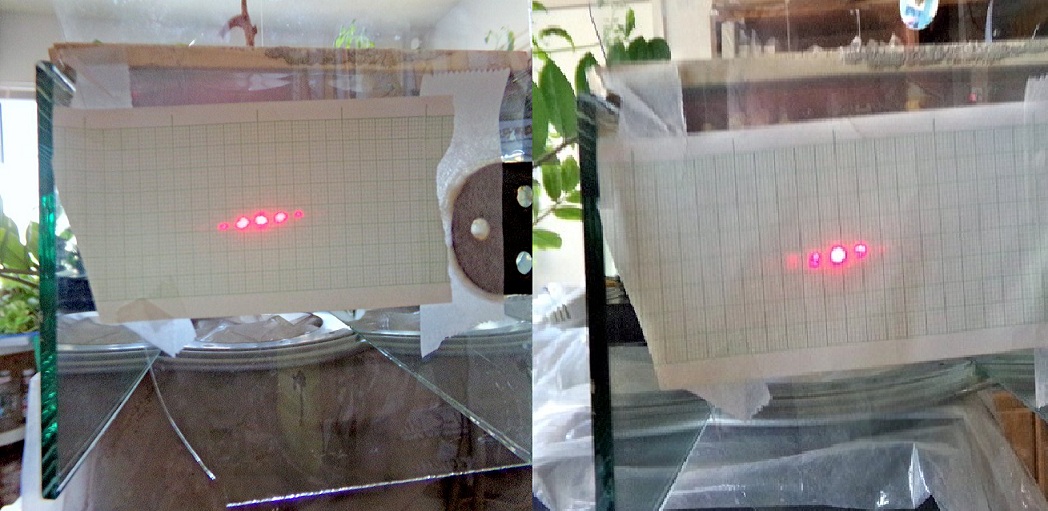
Today, I finally managed to slightly adjust my homegrown “optical system” to test the effect of transverse beam displacement in the Michelson experiment. I made it out of two long parallel mirror plates 53 cm long and a laser pointer.
(See: “On additions to the Special Theory of Relativity”, “An addition to the AUTO-MOBILE”.)
I hasten to admit that I have never created any optical systems in my life, this is the first, and probably the last, because I am by no means a “master of golden hands”! I glued them together using one plastic box and two ceramic plates. I put it on a large rotating bearing. I did all this about two weeks ago, without pretending or even hoping for serious results.
So, today, only after a long and exhausting fuss, I managed to bring the beam reflected repeatedly from the mirrors to the glass door, to which I glued a millimeter ribbon “by eye”.
I looked at it in the position of the beam reflected from the mirrors, when the long axis of the installation is parallel to the Earth’s velocity vector,
(30 km/sec). The beam is moving TRANSVERSIALLY!
Then I turned his structure perpendicular, that is, so that the beam ran back and forth along the Earth’s velocity vector. And I saw with horror that the spot from the laser had shifted by about two millimeters! I did this several times, securing the door and not touching it. I only carefully turned the device with my finger around the axis of the large bearing disk.
In general, I felt like that chess player in Vasyuki who:
“Checkmate! – The frightened brunette stammered. -“Checkmate you, comrade Grandmaster!”
So am I!!!
In theory, THERE SHOULD BE NO DISPLACEMENT, because the beam is deflected towards the movement of the Earth and therefore the exit point of the beam SHOULD HAVE REMAINED IN THE SAME POSITION in both states!
AND IT SHIFTED!
I checked all the mirrors and the door, the ribbon and the laser position. Nothing changed with the careful and smooth rotation of the “optical system”.
But I quickly realized the reason.
The fact is that I DELIBERATELY used mirror plates with THICK GLASS before directly mirroring the silver layer.
Strictly speaking, if you are assembling a certain optical installation, then use the mirrored metal surface of the reflection directly, and not a double one – glass and mirror proper.
(But I was too lazy to wash off the protective paint from the back of the mirrored metal layer with acetone or another solvent. And I was afraid that I would accidentally erase the mirror layer)
The light was attracted by thick glasses, and two competing factors began to operate in the installation: The expected forward deflection of the beam along the Earth’s velocity vector and the additional attraction of the same light with refraction by thick glass plates.
Which, apparently, gave rise to such a “frightening” effect!
But, I admit, it’s a funny exercise for the brain, especially the “scared to death” one!
Faciant meliora potentes.
If I’m wrong, let my seniors correct me.
28 II 2026
P.S. In principle, you can not rotate the installation by 90 degrees, but simply do not touch it during the day. Since the Earth moves not only in orbit, but also rotates around its axis, the installation, along with the Earth’s surface, will be in different positions relative to the Earth’s orbital velocity vector. Then the ray in it will be longitudinal with respect to the vector, then transverse, and the displacements mentioned in the note above should appear.
However, the factor of CONSTANT ambient temperature and, consequently, the installation itself is extremely important here.
If the installation temperature does not change, then there will be no other factors other than the entrainment of light by the glass mirrors.
If the temperature changes, even slightly, it obviously changes the position of the mirrors and the laser, which can cause a strong beam shift.
However, this effect can be used as the basis for an extremely sensitive optical thermometer. The slightest change in the relative position of the mirrors and the light source will change the course of the reflected beam and thus give an accurate value of even very small temperature changes


