As a preface:
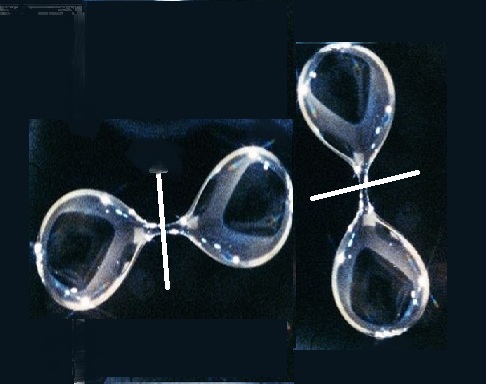
Perhaps such a “stretched-drop” model rotating around an axis perpendicular to the long axis of the particle can serve as the basis for building a successful Theory of Elementary Particles?
The model is visual with a clear physical meaning and offers quite a few types of interaction of both homogeneous and heterogeneous particles with each other.
The interactions are purely Coulomb and magnetic, but due to the difference between both forces – electric and magnetic, and the fact that the magnitude of the Coulomb forces varies proportionally (or inversely) with the SQUARE degree of the distance between the particles, and the magnitude of the magnetic forces (short–range) – similarly, but correspondingly to the THIRD degree of the distance, this gives such interactions a very a diverse character. If we assume that the interaction is NOT between charged and rotating spheres, but “droplets” , as proposed in the articles, then this feature adds much more interesting possibilities for their interaction.
Let’s consider some options:
Pairs of singly charged electrons or protons,
Dissimilar particles like proton and electron, electron and positron, proton and antiproton, antiproton and positron, proton and positron. Of course, other combinations of various particles are possible, including neutrons, mesons, and the interaction of DROPLET particles with possibly also “droplet” nuclei of different elements.
Let’s divide their interaction into several possible situations, as it was already done in the previous article:
Their “frontal” approach and their axes are located on the same straight line.
They are adjacent, located “side by side” and their axes are parallel.
They are adjacent to each other, but their axes are perpendicular to each other (as can be seen in the figure). In my opinion, this situation is most interesting because of the variety of possible interactions.
And even more interesting interactions of two rotating, electrically and magnetically “charged” particles will occur when their axes of rotation are located in different planes!
Their phase ratio will also play an important role, that is, HOW they will rotate relative to each other, whether in phase, out of phase, or with one phase shifting 90 degrees relative to the other.
And this is all based on the tacit assumption that these “droplets” are “solid,” which is a completely arbitrary and unjustified assumption. And if we assume that the “droplets” are capable of rapid and slow deformations under the influence of electromagnetic forces combined with purely mechanical forces (centrifugal, “surface tension”, precessional and relativistic), then this, moreover, expands the range of diverse effects of mutual influence!
It is quite obvious that in some cases there will be some “resonant states”, short-lived bursts of “resonance” of the interaction of both particles.
And, so to speak, these resonances themselves will also be DIFFERENT!
In this article, I have only mentioned and listed a number of possible situations (I admit that not all) of the interaction of such droplet structures, without delving into each case in detail, because anyone can do this, focusing on the proposed options.
Mental games with all possible combinations of particle positions and interactions should simultaneously include Coulomb (electric) interactions, spin magnetic moments and their interaction, and spin-orbital interactions of “droplet parts” of one particle moving at high speed in the magnetic spin field of another particle! (As, for example, it is depicted in the figure when the “electric half of the drop” rotates at high speed in the spin magnetic field of the other!) There are many such variations, and all of them, in my opinion, are very interesting and may correspond to some experimental results, giving them a new interpretation.
Faciant meliora potentes.
If I’m wrong, let my seniors correct me.
16 IX 2025

 Esprit de L'escalier