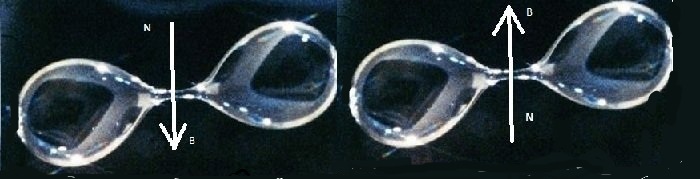
Electrons are the lightest of the elementary particles and their rest mass is 1836 times less than the mass of protons. Since the charges of an electron and a proton are equal in absolute magnitude, such a difference in mass can be due to only one thing: A high concentration of proton charge, which is 12.245 times smaller in linear size than an electron, and 1836 times smaller in volume.
(The cubic root of 1836 = 12.245.)
If we assume the hypothesis that our “physical, geometric” space and time are some kind of changing electromagnetic field, and if we assume the long–standing hypothesis about the extension of the principles of General Relativity to the phenomena of electromagnetism, then it remains to assume that there may be “chargeg black holes” in the electromagnetic field – “Schwarzschild charge spheres”, where the role of mass in the Schwarzschild formula is played by the magnitude of the charge.
These are the elementary particles.
All the others are just composite particles, such as neutrons, hyperons, etc.
Perhaps mesons are also elementary particles, although there is no certainty about this, because particles that decay in millionths, billionths, and less than a fraction of a second cannot be the basis of a stable substantial world. These are most likely some rapid processes of short-term connection and decay of some other particles, PROCESSES that only simulate particles!
If we assume the above, then, perhaps, these “Charge black holes” in their geometric and temporal parameters are related to the wavelength of the electromagnetic field-space-time oscillations. There are certain geometric and temporal limits to their existence.
If a particle “FITS” within these limits, it is stable and long-lived.
If it “DOESN’T FIT”, it is unstable and short–lived.
The funny thing about this hypothesis is that “Black Charge Holes” are microparticles, although “Black Holes”, they are NOT SCHWARZSCHILD SPHERES AT ALL, but two “degenerate ellipsoids” connected to each other, two charged droplets rotating around a central axis perpendicular to their long axes.
I have described such particles in several notes (“Behavior of particle pairs”, “Behavior of particle pairs 2”, “Behavior of particle pairs. P.S.”. August – September 2025)
Of the real elementary particles, stable and long-lived, only four are known: Proton, electron, photon and neutrino and their antiparticles
All the others are more or less short–term processes of joining and disintegrating these particles in various combinations.
And creating the same phantom combinations – illusions of full-fledged particles in the minds of physicists who think dogmatically and in a formal way and want to cram all the variety of processes and phenomena into the next prepared dogmas of the “Holy Physical Scripture.”
Faciant meliora potentes.
If I’m wrong, let my seniors correct me.
18 V 2026


