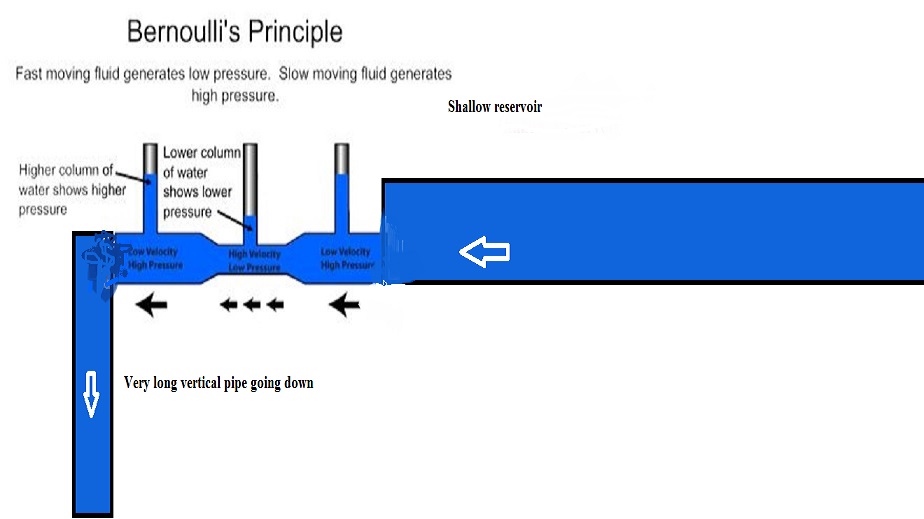
Let’s assume that water is poured into pipes of different diameters NOT from a high tank, but from a large and “shallow” one, and then pours out of a long vertical pipe.
What is the difference here with the “classic” experience?
The fact is that it is NOT the PRESSURE of water in a large, high tank that makes the water flow faster or slower through the pipes, but the weight of a column of pouring water in a long vertical pipe that DRAWS water out of them! In this experiment, water “does not work by compression, but by stretching.”
I think that the results of such an experience will only confirm Bernoulli’s law or theory.
But it is more visual and easily explained in this modification:
Water STRETCHES DIFFERENTLY in wide and narrow pipes.
In wide ones – less, in narrow ones – more.
Thus, its TRANSVERSAL pressure on the walls is also different. Where it is stretched more, its pressure on the walls is less. It is precisely because of its “tension”.
Where there is less tension of the water, its pressure on the walls is greater!
Any liquid, unlike gases, is practically “NOT STRETCHABLE OR COMPRESSIBLE.”
But this does not mean that it lacks the effects of compression and tension.
A classic example of such effects is the phenomenon of cavitation in water (or any other liquid) under the influence of either a powerful ultrasonic wave or the rapid movement of some bodies in it, for example, the propeller of any powered floating object (boat, ship etc.)
It seems to me that just SUCH a variant of Bernoulli’s experiment more convincingly, as if “automatically”, explains the dependence of the TRANSVERSE pressure of a gas or liquid stream on the magnitude of its flow velocity.
Faciant meliora potentes.
If I’m wrong, let my seniors correct me.
6 VI 2026
P.S. According to the theory of intermolecular (or interatomic) interaction of Van der Waals, this interaction is twofold: The attraction of molecules-atoms to each other and at the same time their mutual repulsion. The pressure is caused by the mutual repulsion of molecules-atoms. In a stationary medium, liquid or gas, both of these forces create a certain correct sphere of interaction.
When moving in a gas or liquid stream, such a sphere of attraction and repulsion is transformed into elongated ellipsoid, the long axis of which more or less coincides with the flow velocity vector and is related to it by the degree of elongation. The higher the flow velocity, the more elongated the ellipsoid of the Van der Waals interaction becomes, the lower the TRANSVERSE pressure (and attraction) of the atoms — molecules relative to each other. This is reflected in the Bernoulli effect!
In a superfluid moving liquid (Helium Two) at a certain critical velocity (As in ordinary gases and liquids with a Reynolds number), for the same reason, possibly, that the bonds of pairs of Helium two atoms break and it turns into ordinary liquid helium.

 Esprit de L'escalier