Lecture by the winner of the Nikola Tesla Prize for Epochal Inventions that Changed the Face of Civilization, Ms. Lucia Frantsevna Pferd, Doctor of Technical Sciences, Professor at Yale University, Connecticut, USA.
Dear Ladies and Gentlemen,
I would like to express my deep gratitude to the Nikola Tesla Prize Committee for such a high appreciation of my work. Personally, I have always admired the talent of this outstanding scientist and inventor and his unique ability to solve complex scientific and technical problems in surprisingly simple ways. While achieving absolutely amazing effects.
In this lecture, I will try to present as popularly as possible the essence of the idea that led us to develop and create a “Space Wing” or, more precisely, a “Gas-dynamic wing in a vacuum.”
More than a hundred years ago, aerodynamic scientists developed the theoretical principles of wing design for so-called “heavier-than-air aircraft”, that is, airplanes.
In the West, the works of Reynolds, Magnus, Kutta, Karman, Ernst Mach (Against whose philosophical views Lenin opposed with a lengthy article – a whole book – “Materialism and empirio-criticism”), Fletner, Savonius, and others are widely known in this field.
In Russia, this topic was intensively developed by such outstanding scientists as N.E. Zhukovsky and S.A.Chaplygin.
The idea of the pressure difference on the “lower” and “upper” surfaces of a wing, streamlined by air, gas or liquid flows, appeared earlier in the works of Daniel Bernoulli. But it took years and decades to give the aero-gas-hydrodynamics its perfect look.
In these works, a significant influence on the “lifting force of the wing” was also indicated by the “circulation” of jets of gas or liquid around it.
Based on this, we (a group of my colleagues and I) suggested that, perhaps, in a vacuum, a wing, streamlined by a powerful and sufficiently dense flow of gas or liquid, will also experience the action of all those forces that act in a medium filled with matter (gas, air, liquid). Indeed, such a comparison can be made, bearing in mind, of course, that analogy is not a proof of truth, but can only serve as an illustration of a certain process or phenomenon.
If you put a curved plate like a wing under a stream of liquid flowing from a faucet, it is easy to notice the appearance of a hydrodynamic force acting on the plate in a stream of water. But a jet of water is hundreds of times denser than the surrounding air. For her, the ambient air and the vacuum are basically the same thing.
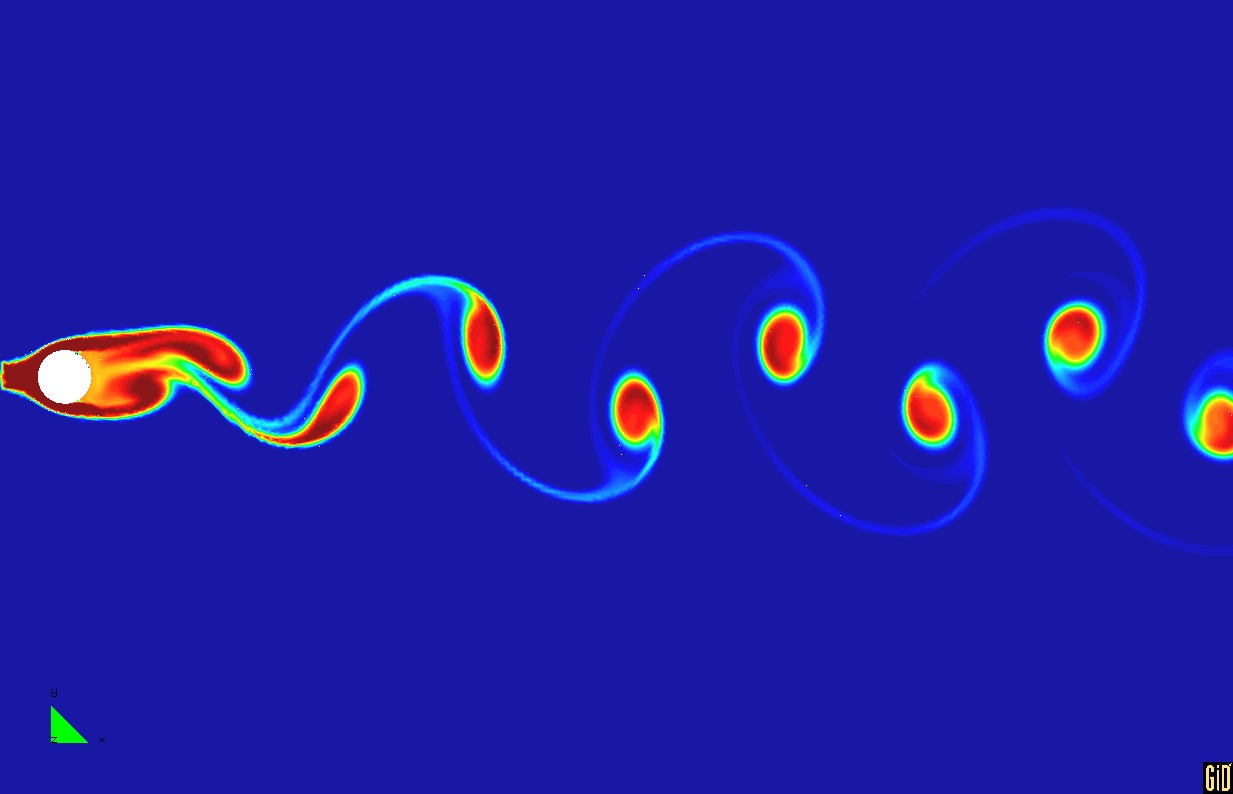
In all known formulas and equations of aero-hydrodynamics, there is NO presence of a gas or liquid medium SURROUNDING the flow! (Except for the “Pocket path”, and even that is considered as a sequence of vortices in a stream blowing over a wing or other object.) We are always talking only about a certain physical object of a certain configuration, a cylinder, or a plate – “a wing, in a stream of matter and forces acting on it from jets of gas or liquid! Again, there is no mention of any gas or liquid ENVIRONMENT SURROUNDING this jet!
And we had the idea to simulate a similar process in a void, a vacuum, when a certain wing is blown by a jet of water or gas into the conditions of the surrounding airless or anhydrous space.
This idea seems logical (from the point of view of aero-hydrodynamic equations), but strange and unusual for specialists, because the process takes place in a void!
Having conducted numerous experiments with jets of gas and liquid in specially constructed vacuum chambers (something like wind tunnels, but without air or any gas filling them), we have made sure on models that the equations of aero-hydrodynamics in general (with minor corrections for the transverse spreading of jets of gas or liquid) are observed in our experiments.
The conclusions, again, logical, but strange and unusual for ourselves, indicated that it is possible to “FLY” on wings in the void!!!
The question is: Why did we need all this “discovery” if rocket engines have been around for almost a hundred years (not to mention the ancient Chinese, who invented rockets for entertainment many centuries ago).and have you fully justified yourself in cosmonautics?
The point is, what kind of power can be obtained in a purely rocket engine and on a wing. A rocket engine, ejecting a certain mass of gas or liquid, develops thrust due to recoil. This force is limited by the mass and velocity of the ejected substance. Nothing else can be changed. But a wing in a stream of gas or liquid can give DIFFERENT “lifting forces” depending on the wing area, angle of attack, its configuration, and other things (say, from the use of ailerons, flaps, and other purely aerodynamic means). And the wing can develop a force greater than just the reaction of a jet of flowing matter. And MANY TIMES!!!
Thus, by using a wing in a vacuum, we increase both the propulsion force of the spacecraft and its maneuverability many times over!
Further experiments in “real” space fully confirmed our assumptions and calculations.
So, if you put two rocket engines on a certain platform, fastened with their “backs” to each other, and through special nozzles that give the gas jets the shape of a flat stream, direct these streams to heat-resistant wings of ANY SIZE (Because there is no “external aerodynamic resistance” in a vacuum), then these wings will give a driving force MANY TIMES GREATER THAN the possible force of the jet thrust generated by these rocket engines!
At the same time, a new branch of aerodynamics was created: “Vacuum gas dynamics”, strange as it may sound.
Our work has proved that it is possible and necessary to “fly on wings” in the void.
That’s what’s being done!
Thank you for your attention!
19 VIII 2015
P.S. All these beautiful arguments would be true if the Kutta-Zhukovsky theorem about all kinds of streams, etc. were true. BUT IT IS INCORRECT AND THE LIFTING FORCE OF THE WING ARISES NOT BECAUSE OF THE PRESSURE DIFFERENCE according to Bernoulli’s law, but because of the deflection of part of the incoming airflow downwards!!


