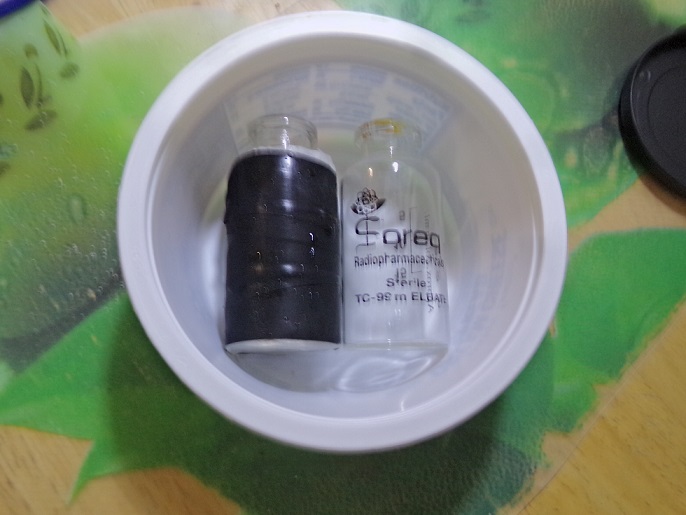
The results:
The original glass bottle (in the photo on the right), placed in a vessel with water, the level of which reaches the upper edge of its neck, and being filled with water to the neck itself, is torn into small fragments by the ice formed in it.
The bottle, wrapped with a thin paper ribbon and electrical tape on top, remained intact, despite the ice that had formed in it, all other things being equal to the conditions mentioned above.
Explanation:
Actually, it’s very strange! If the bottles weren’t in the water, they would both have to be torn apart by the pressure of the expanding ice! The coating of paper and tape does not give the slightest addition to the strength of the glass walls! IN THIS, it is completely identical to the first one, without a “cover”.
On the other hand, if they are immersed almost entirely in water, it freezes BEFORE the water in them. then, in theory, a powerful ice shell from the outside should strengthen the walls so that the ice forming will not be able to break them. A dense solid shell from the outside should resist the pressure of the expanding ice from the inside.That is, the cover of the second bottle does not play the slightest role in its mechanical strength AND which has to be VERY SIGNIFICANT!!! (if this bottle remains intact.)
So, what’s the difference???
THE FREEZING RATE OF ICE outside and inside the bottles!
The freezing zone of the ice spreads outside, from the cold air with a temperature of minus 15-18 degrees Celsius. The heat is taken away first from the outer layers of the water and, as the entire volume freezes, reaches the most central ones.
But the heat transfer of the walls of both bottles is DIFFERENT!
In an uncovered bottle, ice forms relatively quickly when the freezing but still LIQUID water surrounding it has not turned yet from a loose mass into a DURABLE AND SOLID shell of ice. The ice formed in the bottle begins to expand and its pressure cannot be resisted by a thin layer of UNFROZEN WATER or soft “newborn” ice FROM THE OUTSIDE! The bottle is bursting!
In a covered bottle, due to the poor thermal conductivity of paper and electrical tape (unlike glass, whose thermal conductivity is even better than that of ice), the freezing of water inside lags far behind the freezing of water outside the walls! A layer of paper and electrical tape greatly slows down the heat transfer from the water in the bottle to the outside and it turns into ice already when a thick and durable shell of ice has formed around the bottle from all sides, resisting the bursting pressure of the inner ice with its strength. The bottle remains intact!
Faciant meliora potentes!
Let someone explain this phenomenon better! If he can…
18 X 2026


