My most sincere apologies to the readers who forgot school physics!
But this note, which I deliberately did not publish on this portal for many years, is necessary to understand a number of my further, future notes, which MAY or may NOT appear!
The strength of the magnetic field of a moving charge does not depend on the speed of movement of this charge.
(About the physically incorrect formulation of the mathematically flawless Biot-Savart law.)
(From the collection Revisionist Physics)
(1971 — 2 XII 1996, 12 II 2000)
Professor Boryara (Papua New Guinea, University of Port Moresby)
- Bio-Savart’s Law
An experimental law according to which a segment of a conductor of length ΔL, through which a current of force I flows, creates at a given point in M space a magnetic field with a strength ΔH equal to:
ΔΗ = kIΔ Lsin φ / r2, where
r – is the distance from ΔL to M,
φ – is the angle between ΔL and r,
k – is a coefficient that depends on the selected system of units.
I – is the current strength in the conductor
Simplifying the formula for the case when r is perpendicular to ∆L, a segment of a conductor of length L at a distance of r creates a magnetic field with a strength of H if the current through the conductor has a magnitude of I:
H = ki L ∕ r 2
- A provocation.
Let’s consider two thought experiments.
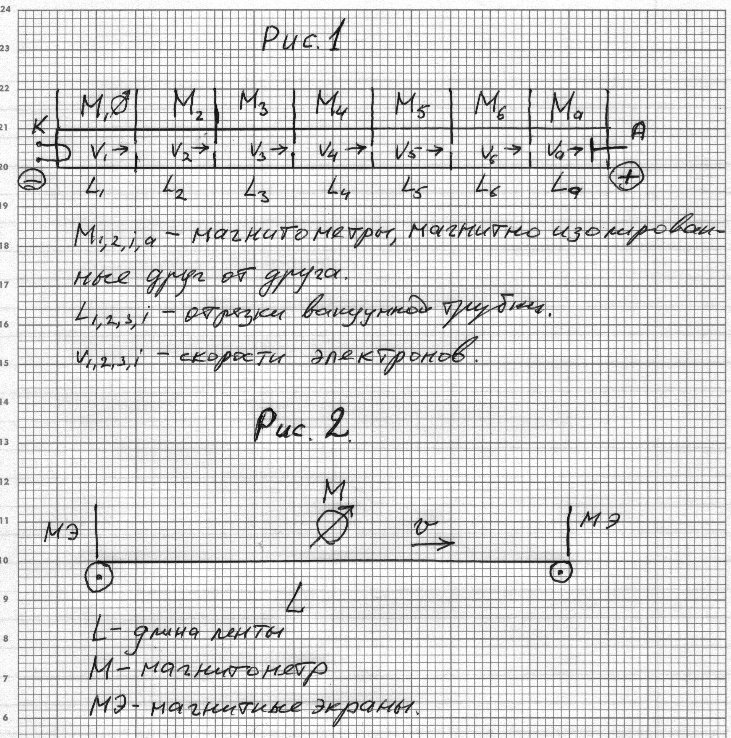
A) There is a long evacuated tube with a heated cathode and anode. (Fig.1) The vacuum in the tube is high enough, so that the electron free path is much longer than the length of the tube. By applying a potential difference to the cathode and anode, we create an electric current in the tube of magnitude I.
We will arrange magnetometers along the tube (near it), magnetically shielding each of them from the other, so that each magnetometer M 1,2, 3, i measures the H generated only by its allotted section of the tube ΔL 1,2,3, i.. All segments ΔL are equal in length. Then, according to the Biot-Savart law, all magnetometers will show the same values of H, because the current I is the same, and the length of each tube segment is the same. That is, H1 = H2 = H3 = H i….
But in the first segment ΔL 1, the velocity of the electrons just emitted by the cathode is low, while in the last (at the anode) ΔL of the anode it is many times higher, because the electrons are accelerated by the electric field in the tube. And although the current in the tube is the same, the electron velocities are very different at the cathode and the anode. The magnetic field strengths along the tube are the same.
Conclusion: the strength of the magnetic field created by moving charges DOES NOT DEPEND ON THEIR SPEED!
B) There is a dielectric tape with evenly fixed electric charges on it. The charge density is the same everywhere, p. The length of the ribbon is L. The ribbon can move with the help of movable rollers at its ends. (Fig.2)
Near the tape, in the middle, there is a magnetometer that measures the strength of the magnetic field created by charges moving with the tape. All parts of the tape outside its active length L are magnetically isolated and cannot affect the magnetometer readings. When the tape moves at a speed of v, electric charges generate a current I = pv, which in turn creates a magnetic field with a strength of N.
Let’s increase the speed of the tape pulling by n times. Then the current will also increase by n times and, all other things being equal, the field strength will also increase by n times.
But the problem is that not only the current I has increased n times. But the speed of the charge carriers also increased by the same number of times. This means that if the strength of the magnetic field also depended on the velocity of the charges, it would have to increase not by n, but by n 2 times! But it only grew n times. Therefore, the strength of the magnetic field does not depend on the velocity of the charges!
However, this conclusion from these two thought experiments contradicts the fundamental statement that it is the movement of charges that creates a magnetic field, and the faster the charge moves, the greater the field it generates. This can be seen, in particular, from the formula for the Lorentz force acting on a charge moving in a magnetic field.
So, a paradox has arisen, which, of course, does not actually exist.
- My explanations.
Of course, the conclusions of part 2 are incorrect and there is no paradox! And the “Bio-Savarists” do not contradict the “Lorentzists.”
The root of the “paradox” lies in the physically incorrect formulation of the Biot-Savart law.
This law is experimental and has been tested in thousands of experiments and billions of applications in all electrical machines. Mathematically, it is also formulated flawlessly, and calculations based on it have also been confirmed in experiments and in practice. But its physical formulation is not entirely correct, and rigorous physical analysis shows this, leading to the aforementioned “paradoxes.”
Let’s pay attention to the talk – I. An electric current, by definition, is a directed and orderly movement of electric charges. The magnitude (or strength) of this current is determined by the number of charges that have passed through the cross–section (of the conductor) per unit of time – Q ∕ t. Note that the velocity of charges does not explicitly appear in these definitions, although we are talking about movement, displacement of charges. The length of the conductor – L is included in the formula of the law as a quantity unrelated to the current. This creates a “paradox”. Instead of the magnitude (strength) of the current and the length of the conductor taken separately, the Biot-Savart law, which is physically correct, should say “the total charge in the conductor is Q, moving at a speed v relative to the point (M) at which we observe a certain magnetic field with a strength of N.” In this formulation, the Biot–Savart law is not very convenient for calculations, it sounds somewhat cumbersome, but it is physically correct and removes these “paradoxes”.
So, the law should be formulated as follows:
The strength of the magnetic field at point M depends on the magnitude of the total charge Q moving at a velocity v relative to this point at a distance r perpendicular to v. (If not perpendicular, we introduce the sine φ into the formula.)
Let us now apply this “new-old” definition of the Biot-Savart law to the experiments described above. Let’s start with the second one.
There is a total electric charge Q on the entire plane of the tape, equal to the product of the surface charge density p by the area S, i.e. pS (in a volumetric conductor, p is volumetric by V is volume). The charge density on the tape does not change from its movement (the tape is rigid and does not stretch), and the length of the tape also remains constant L. By changing the speed of the tape drawing, we only change the speed of movement of the full charge Q relative to the point M and, accordingly, the magnetic field strength at this point changes proportionally. No “square n” appears here (we have replaced “current strength and conductor length” with the terms “full charge and its velocity”)! The “paradox” has been removed.
In the first experiment, for each selected tube segment ΔL 1,2,3, i, both parameters change: the total charge Q i and its velocity vi. Since the charge density in the flow of electrons accelerated in the tube varies linearly depending on the velocity (with an increase in velocity by a factor of n, it also decreases by a factor of n), the product Q i v i remains constant for all segments of the tube, which means that the magnetic field strength induced by them also remains const. The “paradox” has been removed.
Mathematical perfection is not physical perfection! The formula of the Biot-Savart law includes the product I x L . The following mathematical operation is often performed: I = Q/t. In this case, substituting the result into the primary formula, IL = QL/t is obtained, and since L/t is the speed (distance divided by time), IL = qv is obtained, i.e. the product of the charge and the speed at which He’s moving. The physical meaninglessness of such a transformation (in which the right side has a clear physical meaning and the left side is meaningless) becomes clear from the following reasoning:
Firstly, L is not a distance, but the length of the wire, and L/t is a physical nonsense – “the length of the wire per unit of time” – although in terms of dimension, it is speed, everything is mathematically correct!!!
Secondly, let’s assume that the current is 1 ampere (i.e., one coulomb per second), and the wire length is 1 meter. One coulomb is 1.6 x 10 19electrons, and following the above transformation, we obtain the velocity of movement of these electrons (clouds of electrons) – 1m/s. If we increase the length of the wire by 10 times, the electron velocity will also increase 10 times and become 10m/s, while the true electron drift velocity depends on the electric field strength inside the wire, and if the current is still 1 A, then the voltage remains the same! In addition, the physical drift of electrons in a conductor (copper wire) is incomparably slower than meters per second! In copper wires, it is generally impossible to obtain a field strength greater than 0.1v/cm. ” Such a voltage already gives a maximum technical current load of 6 a/mm2. Nevertheless, the swarm of electrons has a velocity of only 0.4 mm/sec in the wires!!!” (Quote from R.V. Pohl, The Doctrine of Electricity, p. 427)
And besides, if you increase the length of the wire to 300,000 km, it turns out that the electrons are drifting along the wire at the speed of light!!! Absurd!
In reality, it will be like this: I = Q/t = pn el V/t, where pn el is the volume density of electrons in the conductor, and V is the moving volume of electrons in the conductor equal to v electrons x S, where S is the cross—sectional area of the conductor, and vp is the electron drift velocity in the conductor. Then I = p el v el S/t; and IL = p el v el SL/t, where SL is the volume of the entire conductor with length L and cross-sectional area S. Replacing SL with VP (i.e. the full volume of the conductor), we write the Biot-Savart law in the form
H = kIL/r2 = k p el V pr v el/r2
In such a formula, the connection between the magnitude of the current and the speed of electron drift along the wire is obvious, and the paradox is removed. It also includes the total charge in the conductor, p el V pr, and the drift velocity of this charge, v el in it.
Summary: The Biot-Savart law in its classical form is not physically correct and must be expressed in the form given on pages 3 and 4.
* From the collection of articles by Professor Boryara: “The Involution of Physics”
12 X 2004
Addendum to the article.
The problem, as I have already pointed out, is actually not in the Biot-Savart law itself.. It lies in an incomplete or physically incorrect determination of the magnitude of the electric current!
If we define the current value not as “an electric charge Q flowing through a cross-section per unit of time”, but as “the number of electric charge carriers with a total charge nq distributed evenly in volume V and passing at a speed U through the cross-section S.“, then
In this form, the law is not contradictory.
It turns out to be cumbersome, but physically true.
Summary again: Good math can be bad physics.


