This experiment is respectfully dedicated to Alexander Popel.
At the suggestion of the aforementioned author, I conducted the experiment of “Diffraction of droplet electrons in two slits.”
Description of the experiment:
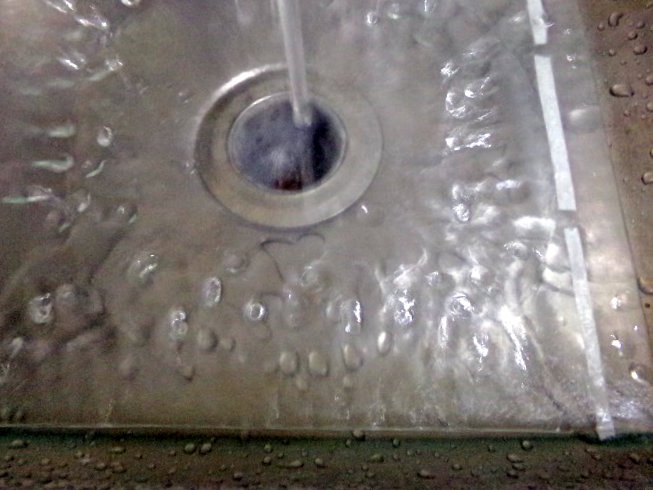
Two paper strips with gaps for the passage of “droplet electrons” are glued to the glass plate. To make the paper strips IMPERVIOUS to water, moistened them with mineral oil.
The flow of water from the faucet spreads from the center along the upper surface of the glass plate, “collapses” onto the lower one, on which the oil strips are glued to the right, and then falls from it into the sink.
As can be seen on the right side of the photo, there is a clear diffraction of “electron waves” behind the slits (the patterns of velocity distribution of “droplet electrons” are noticeably different on the left and right in the nature of the droplet distribution), which once again confirms the presence of “matter waves”, the idea of a young French physicist, Louis de Broglie, put forward by him in 1924.
Louis de Broglie himself was not only a physicist, like his older brother Maurice de Broglie, but also acquired the hereditary title of duke after the latter’s death!
So, the experiment ingeniously conceived by Alexander Popel has been done!
Those who wish can repeat it (to obtain the so-called “REPRODUCIBLE RESULTS”.)
Physics is an EXACT science, and this precision was strictly observed in this “EXPERIMENTUM CRUCIS”.
9 VIII 2026
P.S. A review of “Atomic Drops” (Esprit de L’Escallier)
that is, electrons are still small balls, and not some kind of wave-particle dualism? Can you take a picture of a two-slit experiment with such drops?
Alexander Popel 08/07/2026 08:43 •
Dear Alexander Popel,
Thank you for your attention to my writings!
Special thanks for your developed sense of humor!
First, I will answer the question about “Atomic Droplets”. In my last post, I destroyed my own speculation completely! These are not drops! See “Non-Atomic NON-Drops 3” The only use of these pictures is the initial idea of a funny model of atomic and electronic phenomena. NO MORE!
Electrons, like protons, and any charged particles with their own spin and magnetic moment are NOT BALLS! The hypothesis about their “structure” in the articles “Behavior of pairs of particles” from a year ago.
The balls, which are uniformly charged in volume or on the surface, cannot create a magnetic moment by any rotation, because there are no changes in their electric field during such rotation.
Finally, your justified irony about my constant attacks on wave-particle dualism. I do not believe in it, and the experiment of Sushkin, Biberman and Fabrikant in 1949 with single electrons clearly indicates the absurdity of this postulate. De Broglie’s idea is beautiful, interesting and very useful for constructing new hypotheses and theories of quantum mechanics, but, alas, it does not correspond to reality.
About double-slit diffraction: Why be petty and limit yourself to just two slits? Let’s take a three-dimensional spatial lattice of a single crystal, as in the Davisson-Germer experiment, and let the electrons diffract on it.
Again, an analogy is not a proof.
The phenomenon of wave diffraction developed by Fresnel (the Huygens=Fresnel principle) is mathematically good and true, but its visual similarity to the behavior of microparticles should not be misleading.
Any microparticles QUANTUM interacting with another quantum object such as a slit, hole, or spatial diffraction grating WILL GIVE EXACTLY THE SAME, SIMILAR PICTURE, but THIS IS NOT WAVE DIFFRACTION!
If an electron interacts quantum with chaotic fields of a crystal lattice, BUT THIS INTERACTION IS ALWAYS DICTATED, ABRUPT, and INTERMITTENT, then it will always deviate by a certain angle. A lot of electrons interacting quantum with fields will give a typical diffraction pattern, ONLY VISUALLY SIMILAR to wave diffraction!
If one photon or one electron were a wave, THEN ONE PARTICLE WOULD HAVE TO CREATE A COMPLETE DIFFRACTION PATTERN! And experience shows that one particle gives only ONE POINT on the recording screen or any other device. AND ONLY A LOT OF SUCH POINTS FROM QUANTUM DEFLECTED PARTICLES give a picture similar to diffraction!
Yours with appreciation, Esprit
Esprit de L’Escallier 08/08/2026 02:21


