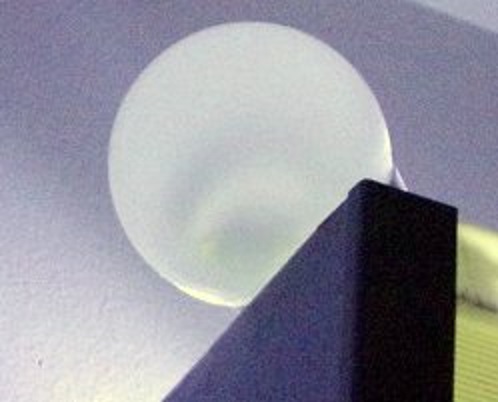
In the photo (you need to look closely!!!)
It took a lot of work until it was possible to take a photo at all, because a glowing lamp or even illuminated by a flashlight from the outside created too much glow and the camera simply lit up with it, completely masking the darkish figures on it!
So, the photo: On the lamp cap made of light-emitting diodes, an outer dark ring of settled dust is visible, then light and dark again in the center! Upon closer examination, I found that the central dark spot has a thin light ring inside again!!! And all the shapes have a pretty regular shape!
An obvious diffraction pattern! Just like Louis de Broglie’s idea of 1924 – “Waves of matter”!
But I don’t believe in that! Moreover, in the “wave character” of dust, when each of its particles has a mass of trillions-quadrillions-quintillions times greater than that of microparticles!
This means that the wave properties are equally smaller!!!
I’ve never seen anything like this before!
What is the reason for this strange phenomenon?
The fact that dust from the air settles on objects is nothing new! It is often electrified (it carries an electric microcharge, which is used in electrostatic filters).
The fact that it settled on the milky–colored lamp cap is also not news!
But no such lamp has ever been covered with a DIFFRACTION PATTERN OF SETTLED DUST,
I have a lot of these lamps in my living room and bedroom and no diffraction!
This phenomenon manifested itself only on one lamp in the bathroom. There are no diffractions on the other two, located side by side!
I have air ionizers working in my bedroom, kitchen and bathroom.
Therefore, I thought that the ionizer played a role here. But there is such a much more powerful device in the bedroom, however, no dust diffraction is observed on all lamps!
And in the kitchen too.
In general, so far, not a single sensible thought has appeared in my head.
The only hint of an explanation is as follows:
For obvious reasons, the humidity in the bathroom is higher than in other places.
(When I have four humidifiers working in the bedroom and living room in winter, there is increased dust deposition on all objects and this dust is not “natural”, but it is salts from evaporated tap water, which I pour liters into humidifiers every 8-12 hours. But again, no diffraction.)
Another clue: Not far from the lamp there is a metal ferromagnetic frame of a hanging cabinet in the bathroom. Perhaps its function as a grounding for ionized dust and its certain magnetic field in combination with the electrostatic plays a role in creating such a shape of fields around the lamp hood that it SIMULATES a diffraction pattern?
Another assumption is that for some reason a certain negative charge is emitted in the lamp itself, settling inside the hood in rings with a center and dust from the air outside is attracted mainly to these areas of the hood?
I can’t think of anything better. Until now!
Faciant meliora potentes!
Truly, let someone do this (to give explanation) better than me.
IF HE CAN!
P.S. The “explanatory part” of the above note is COMPLETELY WRONG, so it’s NOT dust! I hesitated to wipe the cap for a long time, these rings seemed too ephemeral. But, finally, I decided and IT TURNED OUT that these were NOT DUST at all, but formed inside an airtight cap. That is, SOMETHING evaporated inside the lamp and formed such diffraction rings! Or their likeness!
But I still can’t explain this phenomenon!
P.P.S. Placed a strong horseshoe-shaped permanent magnet next to the rings in order to determine whether the flow of particles settling on the cap is electrically charged. Or, if these are ferromagnetic particles, then the picture will also begin to change under the influence of an external magnetic field.
P.P.P.S. Possible explanation of the diffraction phenomenon.
If we assume that somewhere in the lamp, due to the strong heating of the elements, the evaporation of glue or some other substance occurs, then the steam forming passes through narrow holes in the plate of light-emitting diodes, and there are two open electrodes supplying a voltage of about 80 volts to the diode chain. The width of the slots for the electrodes is about one millimeter, which means that the field strength in them at the maximum pulse amplitude is 800 v / cm. The voltage is NOT DC, but pulsating, the LEDs flash (blinking) at a frequency of 60 or 120 times per second.
Let’s assume that this flow consists of ELECTRICALLY CHARGED molecules or vapor atoms, that are, ions. This flow passes through an opening in which a QUANTUM electric field appears and disappears in LEAPS. This means that the particles will also be deflected by them not in the FORM of a continuous uniform CONE, but discretely, in separate conical beams with well-defined deflection angles! Thus, their settling on the cap WILL NOT create a kind of solid spot, but just DIFFRACTION-LIKE RINGS. Since this process is random, the rings formed, of course, do not have a very strict shape of circles with clearly defined edges, they are very similar to the well-known pattern of diffraction of light or electrons on crystals in the Davisson-Germer experiment.
So, the pseudo-quantum discrete interaction of charged ions with charged electrodes in a narrow hole was also discredited and created such a “diffraction pattern”
Let to anybody to explain better, who can!!!
11 XI 2024

 Esprit de L'escalier