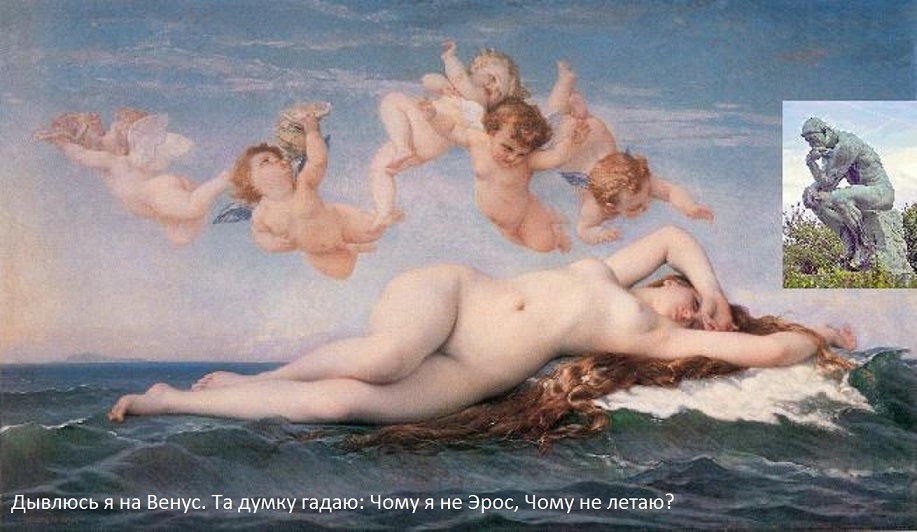
The collage consists of a painting by A. Cabanel “The Birth of Venus” and a sculpture by O.Rodin’s “The Thinker”.
Zhukovsky or Chaplygin or any other “aerodynamicist” can be put in the place of the “Thinker”.
Forced repetition of the 2017 note due to the explanatory AFTERWORD! (See P.S.)
I’m looking at Venus.
I’m guessing right now:
Why am I not Eros?
Why cannot I fly?
A Ukrainian folk song based on the words of T. Shevchenko
The answer to the previous question is: The thoughts in the ass are too heavy!
Aeromathematic tales about streams and circulations (“Works” by Zhukovsky, Chaplygin and other “geniuses”) allegedly generating wing lift.
The simplest experiment with a rotor over a smooth surface of a disk refutes all these ridiculous, but passion as meaningful-looking mathematical spells. Place a certain rotor as close as possible above the perfectly smooth surface of a certain thin disk. There is also free air under it. The rotor, rotating, creates a kind of strong air flow of jets over the upper surface of the disk, from the center of the disk to the periphery, while there are no jets at all under the disk, and therefore atmospheric pressure.
Above, according to Bernoulli’s law, the pressure is much lower than atmospheric pressure. This means that the disk with the rotating rotor should rise up, or at least lose a lot of weight.
The experience on the scales showed only slight vibrations of the arrow of the scale and not a constant lifting force from a fairly powerful rotor! So all these “arguments” about the difference in the velocity of the jets flowing around the wing from above and below, as well as the auxiliary “circulation” and the passion created by them as a large pressure difference on the lower and upper surfaces of the wing are nonsense, mathematical nonsense!
Is Bernoulli’s law of pressure drop in a moving stream correct? Faithful beyond a doubt. But his “aerodynamic winging” is wrong. But let’s assume that these wise ideas about trickles are true. Then let’s ask a natural question: If the pressure above the wing is lower than atmospheric due to “fast-moving jets”, then all the overlying layers of air under normal atmospheric pressure should immediately rush to the wing from above and equalize this dropped pressure, and, moreover, rushing to the wing from above, they, these masses of air We have to push the wing down! So where does the “lifting force” come from?
In fact, the main lifting force of any wing arises from throwing significant masses of air (or water for a hydrofoil) down. The wing deflects the air masses running into it at high speed downwards at a certain angle, and due to this deflection, the lifting force is created. To do this, during takeoff and landing of the aircraft, additional flaps are extended, which are located to the incoming flow at a much greater angle than the main wing, and thereby deflect the air masses more downward, creating additional lift at a lower speed. And when the plane took off and gained a sufficiently high speed, the flaps are no longer needed, because they only provide additional resistance, therefore they retract back into the wing.
It’s funny that this is clearly demonstrated in the formulas for calculating the lifting force of a helicopter’s propeller, in which no one even stutters about any jets and circulations, but the calculation is about the mass of air thrown down at high speed by the helicopter’s rotor! According to Newton’s third law, there is an upward reaction force on the screw. The same applies to any wing, because the rotor blade of a helicopter is nothing more than a rotating wing!
“Funny,” I wrote, because all the aerodynamicists don’t seem to notice the striking similarity between helicopter rotor blades and airplane wings. And calculations are carried out using completely different formulas and theories. Although both cases are IDENTICAL! The only difference is that the wing of the aircraft does not move rotationally, but translationally. But there is no fundamental difference in the mechanism of creating lifting force for both!
6 X 2017
P.S. The last paragraph is not entirely accurate! The calculation of the lifting force of an aircraft wing is carried out USING the SAME formula as the calculation of the lifting force of a helicopter propeller. Thus confirming IN PRACTICE the absurdity of all this empty chatter in physics textbooks, both for schools and universities, about all sorts of “incoming-flowing streams” and Bernoulli’s law!
The disk example clearly shows the absurdity of applying Bernoulli’s law to create the lift of a wing or blade.
Is Bernoulli’s law true or false?
Undoubtedly true, but FALSE, as an explanation of the lift of an airplane wing or helicopter propeller!
An example from a school textbook: Two pieces of paper hang parallel to each other at some distance. If we blow between the leaves, they will abruptly get closer to each other, they may even “stick”. Bernoulli’s law!
But then why can’t it be used for a wing?
Very simple. That childhood experience again. Indeed, due to the rapid movement of air between the sheets of paper, the pressure in this space dropped and the external atmospheric pressure shifted the sheets!
But, and THIS IS THE WHOLE “SECRET”, the low-pressure zone between the sheets was “protected” from the invasion of “outside air” by the very jet of air from our breeze. When the jet entered the “interleaf” space, it carried additional air with it. When exiting, its PRESSURE PREVENTED the outside air from entering and thereby equalize the pressure outside and in the gap between the leaves. Therefore, the pressure inside the slot really decreased and the external air pressure brought the sheets closer together!
And the upper surface of an airplane wing or helicopter propeller is NOT PROTECTED from the immediate “invasion” of higher-lying air masses under normal atmospheric pressure! That’s why all these stories about trickles, circulations and other nonsense in textbooks are wrong!
A simple “childish” experience, and how important and sometimes difficult it is to understand the essence of the phenomenon in detail!
27 V 2019

 Esprit de L'escalier